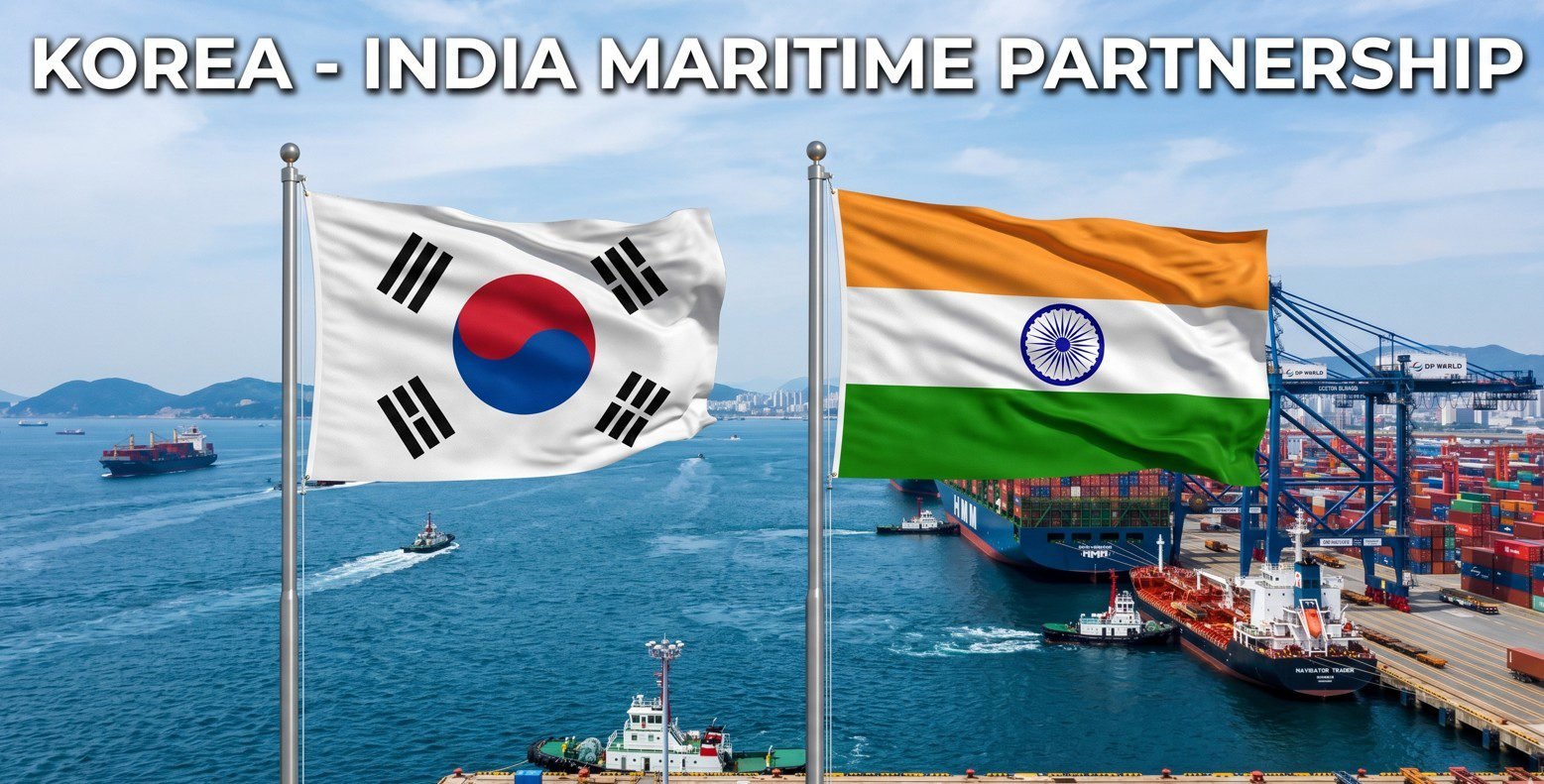
The global maritime landscape underwent a profound transformation in late April 2026. During a high-stakes state visit to New Delhi, the President of the Republic of Korea and Prime Minister Narendra Modi signed a comprehensive maritime framework. This agreement officially elevates the Korea-India Maritime alliance to the center of the global Blue Economy. Specifically, the two nations established a $10 billion investment roadmap. This capital focuses on developing smart shipyards and green maritime technologies. This collaboration seeks to transform India into a premier shipbuilding hub by the year 2030. Furthermore, the partnership introduces the “Busan-Mumbai Green Corridor.” This corridor utilizes carbon-neutral vessels for bilateral trade. Consequently, this summit marks the end of traditional maritime relations and the start of a tech-led oceanic era.
Notably, the most critical aspect of this development involves the “K-Ship” technology transfer initiative. South Korea currently leads the world in high-tech shipbuilding. Therefore, the commitment to share expertise in autonomous navigation and hydrogen propulsion with Indian shipyards is revolutionary. Facilities in Cochin and Visakhapatnam will soon produce world-class LNG carriers and ammonia-powered ships. This move directly supports India’s “Maritime India Vision 2030.” Moreover, the deal includes a joint venture for deep-sea mining exploration in the Indian Ocean. This venture focuses on extracting rare earth minerals. These minerals remain essential for the global semiconductor industry. Ultimately, the 2026 summit provides a blueprint for how two democratic powers can secure the seas while driving industrial innovation.
The Blue Economy Synergy: Sustainable Growth in 2026
The term “Blue Economy” refers to the sustainable use of ocean resources for economic growth. Initially, most nations viewed the ocean merely as a medium for transport. However, the Korea-India Maritime partnership redefines this perspective. It focuses on oceanic health and technological efficiency simultaneously. Specifically, both nations recognize that the future of global trade depends on decarbonizing the shipping industry. Furthermore, India offers a vast coastline of over 7,500 kilometers. In contrast, South Korea provides the world’s most advanced maritime research and development infrastructure. Therefore, this synergy creates a perfect environment for testing new marine technologies. Additionally, the partnership emphasizes “oceanic circularity.” This concept ensures that maritime activities do not degrade the marine ecosystem. Consequently, the two nations are developing biodegradable materials for fishing and offshore infrastructure. Notably, this focus on sustainability attracts significant interest from ESG-focused global investors.
Core Pillars of the 2026 Maritime Framework
- Decarbonization: Developing green methanol and ammonia-powered cargo ships.
- Digitalization: Implementing “Digital Twin” technology for real-time shipyard management.
- Resource Exploration: Joint research in sustainable deep-sea mining for battery minerals.
- Coastal Resilience: Building AI-powered early warning systems for tsunamis.
High-Tech Shipbuilding: From Iron to Intelligence
South Korea currently holds the top position in global orders for high-value-added ships. Specifically, their shipyards excel in producing vessels that carry liquefied natural gas (LNG). Therefore, the Korea-India Maritime partnership brings this sophisticated manufacturing capability to Indian shores. Moreover, the partnership targets the development of autonomous “Smart Ships.” These vessels use AI to optimize routes. Consequently, they reduce fuel consumption by 20%. Indian shipbuilders are transitioning from traditional steelwork to advanced system integration. For instance, the new “Smart Shipyard” in Gujarat will utilize 5G-enabled IoT sensors to monitor production in real-time. Furthermore, South Korean engineers are training Indian technicians in precision welding for cryogenic tanks. Notably, this tech-sharing model ensures that India builds the smartest ships in the world. Similarly, the integration of 3D printing for spare parts on board vessels marks a significant leap in maritime logistics.
Comparative Maritime Capabilities (2026 Projections)
| Feature | India’s Current Status | South Korean Contribution | 2030 Strategic Goal |
| Shipbuilding Rank | Global Top 20 | Global Top 1 | Global Top 5 |
| Fuel Technology | Heavy Fuel Oil (HFO) | Green Ammonia/Hydrogen | 100% Green Fleets |
| Yard Automation | Low (Manual Intensive) | High (AI/Robotics) | Fully Automated “Smart” Yards |
| Logistics Speed | Moderate Port Turnaround | High-Speed Digital Tracking | 40% Reduction in Port Time |
Smart Ports and the Logistics Revolution
Shipbuilding represents only one half of the equation. Port efficiency represents the other. Specifically, the Korea-India Maritime partnership focuses on the “Port-Led Development” model. Consequently, major Indian ports are adopting South Korean terminal automation technologies. These systems allow for the seamless loading and unloading of containers. Therefore, the turnaround time for ships in Mumbai and Chennai will likely decrease by 30% by next year. Furthermore, the introduction of the “Maritime Blockchain” ensures transparent and secure documentation. This digital ledger tracks cargo from the shipyard to the final customer. Notably, this reduces administrative delays and prevents fraud in maritime logistics. Additionally, the partnership includes the development of “Cold Chain” logistics at ports. This remains essential for the transport of pharmaceuticals across the Indo-Pacific. Moreover, South Korea is helping India build inland waterway terminals. These terminals link coastal ports with the hinterland effectively. Ultimately, this creates a frictionless trade network that spans the entire subcontinent.
Geopolitics and the Indo-Pacific Security Framework
Beyond economics, the Korea-India Maritime partnership carries immense geopolitical weight. Specifically, both nations seek a “Free and Open Indo-Pacific.” Therefore, maritime security remains a cornerstone of this collaboration. Consequently, the Indian Navy and the Republic of Korea Navy have increased joint exercises. These drills focus on anti-piracy and disaster relief operations. Furthermore, the partnership involves the co-production of naval assets. Notably, the two countries are collaborating on next-generation corvettes. This ensures that both nations possess the hardware required to protect critical sea lanes. Additionally, the maritime agreement includes a “Submarine Rescue Information” sharing pact. This provides an extra layer of safety for submariners. Similarly, the focus on “Maritime Domain Awareness” helps both countries monitor illegal fishing. Consequently, this security alliance acts as a stabilizing force in an increasingly volatile region.
Rare Earth Minerals and the Deep-Sea Frontier
The deep-sea floor contains vast quantities of cobalt, nickel, and manganese. Specifically, these minerals are the lifeblood of the electric vehicle (EV) industry. Therefore, the Korea-India Maritime partnership includes a dedicated “Deep-Sea Mining Research Center” in Goa. This center focuses on developing “Low-Impact” mining robots. These machines can extract minerals without destroying the surrounding marine habitat. Furthermore, South Korea’s expertise in robotics complements India’s deep-sea exploration vehicle, “Samudrayaan.” Consequently, the two nations are preparing to launch joint missions into the Central Indian Ocean Basin. Notably, this collaboration reduces India’s dependence on traditional terrestrial mining monopolies. Moreover, it positions the partnership at the forefront of the global energy transition. Additionally, the research conducted at this center will likely lead to new biological compounds. Ultimately, the deep-sea frontier represents the next great economic gold mine for this strategic alliance.
Conclusion: Sailing Towards a Multipolar Maritime Order
The Korea-India Maritime partnership in 2026 is a testament to the power of technological diplomacy. Specifically, by merging India’s scale with South Korea’s innovation, the two nations are defining the future. Consequently, the global maritime industry is watching this partnership as a model for sustainable growth. Therefore, early adopters in the tech and logistics sectors should prepare for a massive wave of innovation. Furthermore, the shift toward green shipping will create thousands of high-tech jobs. Notably, this partnership ensures that the Indo-Pacific remains a zone of prosperity. Similarly, the focus on deep-sea resources secures the supply chains of the future. As we move closer to 2030, the results of this maritime alliance will become even more visible. Specifically, every smart device we use and every green product we buy will likely have a maritime connection to this partnership. Ultimately, India and South Korea are not just building ships; they are building a new, sustainable multipolar world.