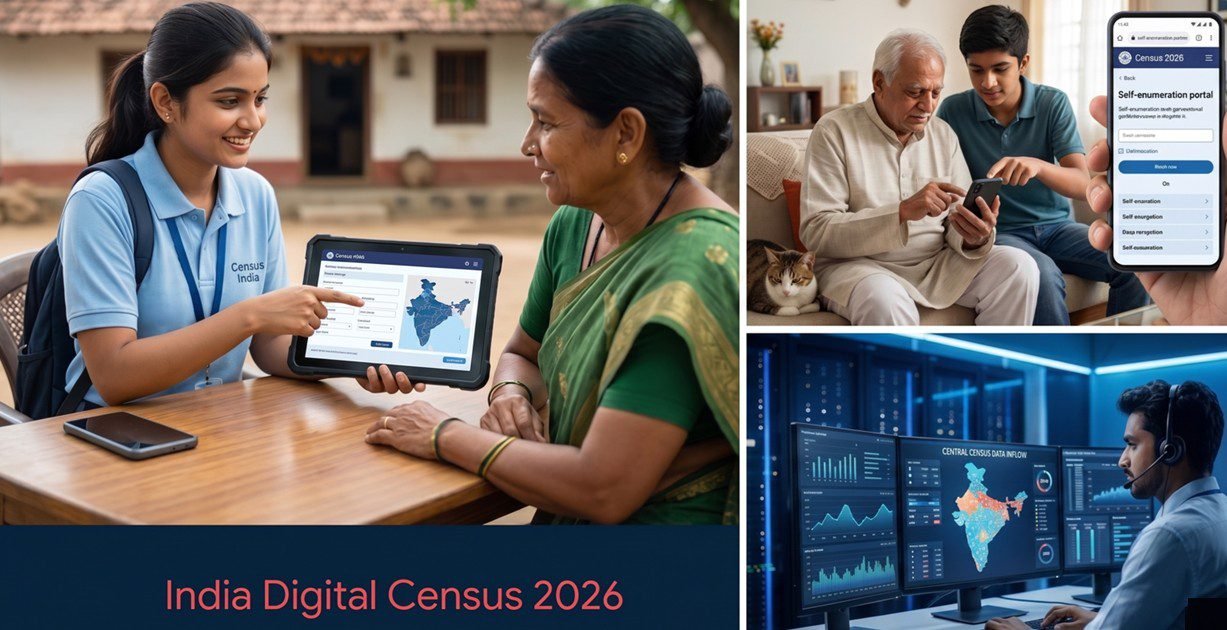
India stands at the threshold of a historical data revolution. As of April 2026, the Ministry of Home Affairs has officially launched the first phase of the decennial census. This exercise marks a global milestone. Specifically, it represents the first time a nation of 1.4 billion people has completely abandoned paper for a digital-first architecture. Enumerators across the country are now using a sophisticated, multi-language mobile application to capture household data. Consequently, this shift eliminates the need for nearly 30 lakh physical registers. Furthermore, the government has introduced a secure self-enumeration portal. This allows tech-savvy citizens to fill out their details independently. Because of this innovation, the Digital Census 2026 will provide the most accurate and real-time demographic snapshot in history.
The importance of this transition extends beyond mere convenience. For instance, legacy paper-based systems often resulted in data lags of several years. In contrast, the new Digital Pulse system processes information through a centralized Census Management and Monitoring System (CMMS). Therefore, policy-makers can access granular socio-economic data almost immediately. This allows for more precise resource allocation in areas like healthcare and education. Moreover, the integration of Geotagging ensures that every building is mapped with GPS coordinates. This high-tech approach turns a massive administrative task into a streamlined, AI-assisted operation. Ultimately, this census serves as the backbone of “Viksit Bharat,” providing the data required to propel India into a developed nation by 2047.
Transitioning to Digital Governance: A Technical Leap
The move toward a Digital Census 2026 required an unprecedented technological stack. Engineers designed the entire system to be robust, secure, and user-friendly. Specifically, the framework relies on three primary pillars: the enumerator app, the self-enumeration portal, and the cloud-based monitoring system.
The Enumerator Mobile Application
Field workers now carry tablets or smartphones instead of heavy bundles of paper. This mobile app supports 16 languages to cater to India’s diverse population. Consequently, the app reduces errors by using drop-down menus and logical validation. For example, if an enumerator enters an age that contradicts a birth year, the app flags the entry instantly. Furthermore, the application works offline in remote regions. Once the enumerator reaches an area with connectivity, the device syncs the encrypted data to the national server.
The Self-Enumeration Portal for Early Adopters
The government understands that the modern Indian citizen is digitally empowered. Because of this, they launched the “Self-Enumeration” facility. Citizens can log in via a mobile-based OTP system. Afterward, they can answer the mandatory 31 questions at their own pace. Transitioning to this model reduces the burden on field staff. Similarly, it ensures higher privacy for individuals who prefer not to share details with a visiting official. Once the citizen submits the form, they receive a 16-digit Digital Reference Number (DRN). They simply show this code to the enumerator during the verification phase.
Technical Architecture and GIS Integration
At the heart of the Digital Census 2026 is the integration of Geographic Information Systems (GIS). This technology transforms static data into a dynamic spatial map. By using high-resolution satellite imagery, the Office of the Registrar General can identify every household in a given block.
Geotagging and Mapping Accuracy
Every entry in the census is now linked to a specific geographic coordinate. Specifically, this prevents the duplication of data. It also ensures that no household is missed in dense urban slums or remote mountain villages. Furthermore, administrators can use this spatial data to map the proximity of residents to public services. For instance, they can determine exactly how many households are within five kilometers of a primary health center. Consequently, this “spatial census” becomes a powerful tool for urban planners.
Census Management and Monitoring System (CMMS)
The CMMS acts as the brain of the operation. It allows supervisors to track the progress of thousands of enumerators in real-time. If a specific district shows a lag in data collection, the system alerts the district magistrate immediately. Moreover, the platform uses AI algorithms to detect anomalies in data patterns. For example, if multiple households in a region report identical assets, the system flags the entries for manual verification. This ensures that the integrity of the data remains uncompromised.
Security and Data Privacy: The DPDP Act Framework
Privacy is a primary concern for tech-savvy professionals during any digital exercise. Fortunately, the Digital Census 2026 operates under the strict guidelines of the Digital Personal Data Protection (DPDP) Act of 2023. This legal framework ensures that citizen data is handled with the highest level of confidentiality.
End-to-End Encryption
The data travels from the enumerator’s device to the national data center through multiple layers of encryption. Specifically, the system uses AES-256 standards, making it virtually immune to external breaches. Furthermore, the mobile app does not store the data locally once the sync is complete. This prevents data leakage in case a device is lost or stolen.
Purpose Limitation and Anonymization
Under the DPDP Act, the government can only use census data for statistical and planning purposes. Consequently, personal identifiers are removed before the data is shared with various departments. This means that while a policy-maker might know how many people in a ward need clean drinking water, they will not know the individual names of those residents. Therefore, citizens can participate with the confidence that their private lives remain private.
Comparative Analysis: Legacy vs. Digital
To understand the magnitude of this shift, we must compare the current exercise with the 2011 Census. The differences highlight the speed and efficiency of the new digital pulse.
| Feature | 2011 Census (Legacy) | 2026 Census (Digital) |
| Primary Medium | Paper Questionnaires | Mobile App / Web Portal |
| Data Collection Time | 12 – 18 Months | 6 – 8 Months (Estimated) |
| Data Accuracy | Subject to manual entry errors | Automated validation and logic checks |
| Geographic Precision | Approximate (Census Blocks) | Pinpoint (GPS/Geotagging) |
| Monitoring | Manual reporting (weekly/monthly) | Real-time CMMS Dashboard |
| Citizen Participation | Face-to-face interview only | Self-Enumeration Option available |
| Results Publication | 1 – 2 Year Lag | Near Real-time (Provisional) |
Socio-Economic Impact of Real-Time Data
The transition to a digital pulse has profound implications for India’s economic growth. Accurate data is the foundation of every successful government scheme. Because the Digital Census 2026 provides high-frequency data, the impact on “Ease of Living” will be significant.
Precision in Welfare Schemes
In the past, welfare programs often relied on outdated data from the previous decade. Consequently, many deserving families were left out of the loop. However, the new digital system allows for “dynamic eligibility.” Furthermore, the government can integrate census data with other digital platforms like the Pradhan Mantri Jan Dhan Yojana. Similarly, this allows for the seamless delivery of subsidies and benefits to the last mile.
Urban Planning and Infrastructure
Modern cities require smart planning. By using the GIS data from the census, municipalities can identify where to build the next metro station or water treatment plant. Moreover, the data helps in disaster management. Specifically, in the event of a flood or earthquake, rescue teams can use the digital census maps to identify the number of people trapped in specific buildings. This level of granularity saves lives.
Challenges and Overcoming the Digital Divide
Despite the technological brilliance of the Digital Census 2026, challenges remain. Specifically, the “digital divide” in rural India poses a hurdle for universal self-enumeration. Nonetheless, the government has designed a hybrid model to ensure inclusivity.
Training the “Digital Army”
The government has trained nearly 30 lakh enumerators to act as digital guides. Furthermore, these field workers assist citizens who are not comfortable with smartphones. Specifically, they use the mobile app to record data on behalf of the household. This ensures that even the most remote citizen is counted in the digital pulse. Consequently, the technology serves as a bridge rather than a barrier.
Infrastructure Readiness
Maintaining a cloud-based system for a billion people requires immense server capacity. Therefore, the National Informatics Centre (NIC) has upgraded its data centers to handle the massive traffic. Moreover, the system uses edge computing to reduce the load on the central servers. This prevents the “crashes” that often plague large-scale digital platforms during peak hours.
The Future: Toward a Continuous Census?
The success of the Digital Census 2026 opens the door for a future where a decennial count might no longer be necessary. Specifically, some experts suggest moving toward a “continuous census” model. In this scenario, administrative databases like birth and death registries would update the national population count in real-time.
Integration with National Registries
If the digital pulse integrates with the Civil Registration System (CRS), the data remains live. Consequently, the government would not need to wait ten years to know the current population. This would revolutionize urban planning and economic forecasting. However, such a move would require even stronger privacy safeguards. Nonetheless, the infrastructure built for 2026 is the first step toward this futuristic vision.
Conclusion: Setting a Global Benchmark
India’s Digital Census 2026 is more than just a survey; it is a testament to the nation’s technological prowess. By launching the world’s first truly paperless census at this scale, India is setting a benchmark for other countries. Professionals and early adopters should view this as a pivotal moment in the history of governance. Specifically, it proves that technology can be a force for radical transparency and efficiency. The data collected during this exercise will shape the destiny of India for the next decade. Therefore, participation is not just a duty but an opportunity to be part of the nation’s digital growth story. As the enumerators finish their rounds and the cloud servers compile the results, the “Digital Pulse” of India will beat stronger than ever before. We are no longer just a nation of people; we are a nation of data-driven citizens building a smarter, more equitable future.